Let the children be creative

Being a mother of a 10 month old girl, I pay attention to the messages dedicated to parents and I found myself surrounded by products, services and articles, which are suppose to boost children’s learning skills and creativity. I would say that creativity is on the top of the list of abilities which can be developed through interacting with toys, attending classes, playing specially designed games, and even – eating! I recently bought finger food, which apparently has a number of learning qualities, as the text on the bag stated. I pictured a baby, asking their parents who are looking for the signs of learning processes while the child is having a snack: ‘please, let me eat in peace.’

This obsessive attempt to influence and enhance babies’ experience introduces the pressure of competition in very early stage.
The holy Grail of our society is the underlying promise behind all the products and stream of information that as long as parents stick to the certain strategy, they will be able to develop their children in the ‘right direction’.

Lets focus here on the creativity at the early stage of children’s life. Parents want their children to be creative and they easily find the support in their quest of how to make them be more creative. I would argue that this is tackling the matter from the wrong angle and consequently, setting up wrong parental goals.

The most popular definition of creativity states, that this is the ability to generate novel outcomes that are valued in particular context. The playful way of explaining the subject is the ‘Laconic Definition of Creativity’, which focuses on the three types of spontaneous reactions for the creative outcome. These three are 1) Ah! 2) Aha!, and 3) Hahaha!, which stand for: enchantment, understanding and amusement. If we find ourselves experiencing those three reactions, that means, we are exposed to the creative outcome.

We can now recall any encounter with the toddler, playing freely with the world. Inventing words, games and jokes, making sense of the surrounding, discovering new things and giving them meaning – being endlessly imaginative. If we are just engaged with this kid, we can find ourselves with Ah! Aha! and Hahaha!, coming out of our mouth every second minute.

Creativity is the natural way of being for babies and toddlers. They engage with world creatively simply because they don’t know any other way. They don’t have schematic ways of thinking and cognitive paths which are adults’ shortcuts to solutions and quick answers. They make up the answer each time and they have fun doing it. They repeat their mile stone discoveries and they learn. The most spontaneous and obvious way of engaging with the world is play. And children’s free play is a pure creativity.

It can be inhibited though, by stress, emotional and psychological discomfort. This can have many different sources, child is affected by the difficult life events, as any other human being (even if is not able to fully comprehend the situation).
Melanie Klein, child psychoanalyst, discovered that stressed and troubled children played with toys in a very particular way, which was unimaginative, repetitive, and tense. When she named what was going on for a child (offered them her interpretation), the children came back to themselves and they were able to play more freely. We can assume what were the ‘curing’ factors, which allowed children to come back to their creative selves. It was an adult, being able to:
help them make sense of the difficult situation which affect them,
contain overwhelming emotions,
provide safety and trust.

I would draw an analogy between this difficult situation and parents’ goals in supporting children’s creativity. Parents’s objective is to provide comfort, safety, freedom and trust, which are basics for a spontaneous exploration of the world. Our task is also to help the children understanding their emotions and going through emotionally difficult times. This is how we can participate in our children’s development of creativity.

I therefore argue for changing perspective from trying to be an active agent, who provides children with tools for more efficient development, to being a good companion, ready to follow children in their creative endeavours and step in when it is needed.

I would like to make this point stronger by recalling one famous person, who was a genius student of creativity and wisely choose his teachers. Pablo Picasso was fascinated by children’s creativity and he learnt how to truly come back to this purely creative state of mind, which gets lost with time. He achieved a mastery in freeing his imagination from constrains and schemata, which force most of us to think, feel and see things in a right, acceptable by the majority way.
If we could reverse the situation and learn from children, rather then instantly attempting to teach them, both children and parents would benefit. Perhaps we resist this because we have an underlying fear, that as a side effect of creativity, we would become less conformist…. and that would force us to face ourselves in new ways…. Creativity is much sought after, but so is conformity!
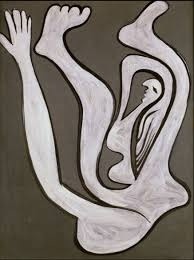
20140511-113014.jpg

Pablo Picasso, Female Acrobat, 1930. http://www.studyblue.com

Reel Parents…Unreal Babies

This post was written by the guest blogger – Simon Western. Thank you Simon for your thoughtful contribution!

Reel Parents…… unreal babies 

Parent baby cinema groups – what they tell us about societies view of babies

Reel parents is one of the names given to the parent and baby screenings now showing at cinemas. This is an interesting idea, parents can take babies under 1 year, and watch a movie together with other parents and babies. A good business idea for the cinema and a good for parents who often can’t get out in the evenings. However, I was shocked to see 12 Years A Slave as a Parent And Baby Screening, and realised other films with loud and violent scenes were being shown. I wondered what this says about our social attitude towards babies? What it says to me is that babies are considered as some sort of pre-human object, rather than being treated as human subjects in their own right.
I have seen no social comment on this practice, except something in Poland which I will return to. Do we imagine babies are unable to engage with the sounds of screaming men and women being whipped, or affected by brutal images on large screens in front of them, or too the emotions stirred in the mothers and fathers watching? The IMD film company warns parents of older children that this film shows “A naked woman is shown being savagely whipped. At one point, 12 Years A Slave is a very brutal, cruel film. It is extremely emotional and some viewers may find it hard to watch. Lots of torture, violence and abuse is shown realistically.

 Some people may be disturbed by the sexual abuse of one of the female slaves. A mother is also sold and separated from her children.” And they mark it 9/10 for being disturbing.
I don’t claim to be an expert on what babies can see on big screens, but I do know that my 9 month year old converses with me on Skype when I am working away from home, and enjoys watching the Jungle Book on You Tube. I therefore imagine young babies can see something of what is happening on huge screens and I am certain babies take in the sounds of screams and violence. One thing is for certain, that babies are completely in touch and sensitive to a parents emotional reactions (hence attachment theory). So parents watching images or rape and whippings, and reacting to disturbing narratives on screen will be passed onto the infant is some form.
The question this raises for me is are babies emotionally neutral objects who are numb to the emotional lives of their parents and their environment, or are they human subjects from birth, with deeply sensitive emotional lives? One place where there was protests against such films being shown was in Poland where I heard that the Catholic conservative right, prevented a showing Nymphomaniac at a parent and baby screening. Of course this fits with their conservative political agenda (sex is sinful, films like this destroy family values etc etc). What I found interesting is that ‘progressive mothers’ argued that it was their cultural right to see any film they chose, and they shouldn’t be prevented from this liberty. This so-called progressive voice is in fact the opposite. It was the Victorians who treated children as emotionally neutral objects ‘who should be seen and not heard’ and packed them off to prep-boarding schools and outsourced them to nannies as quick as possible (not unlike the Royal family today). Zizek speaking to radical protesters said “Don’t be afraid of words like work, discipline, community and so on. We should take all this from the right wingers. Don’t allow enemy to take from you to determine the terrain of the struggle.” (Zizek 2011) This is true of progressive parents who should not take a self-righteous narcissistic view ‘I have the right to see the film whatever it is’ as this is a reactionary and conservative position. The progressive position is to stand up to social norms that demean the humanity of a baby.

The issue of parent and baby screenings of violent films, highlights two disturbing social trends. Firstly, it’s the parents that matter not the babies, reflecting our increasingly narcissistic society. Secondly how babies are increasingly becoming commodities, passive objects of desire, a nice thing to have a push around in a designer pushchair.
Both trends seem to forget that babies are deeply emotional human subjects and need to be engaged with as such, by parents and by wider society.


Parents on the wire

Balancing Parents is a circus metaphor. It takes incredible courage and stamina to walk on the wire with a pole, or dance at heights, having total confidence on another acrobats’ grip. The art of balance is mastered through the hard work, resilience and confidence. At the beginning, when the acrobat is learning their skills, he is fuelled by the imagination and the beauty of the idea.
To be a parent is about balanced judgments, decisions and actions, being worked out everyday. It is about balancing between contradictory thoughts, needs and emotions. It requires keeping a mental and physical balance, in the face of constant challenges.
Parenting is exciting, beautiful and as heroic as acrobatics. It is also equally exhausting, insane and difficult.

The way we act as parents and thus, relate to our children, is strongly influenced by a culture and society we live in. Western culture has created an image of ‘the good parent of our times’, which is present in media, literature and common knowledge. It speaks through our relatives and friends, midwives and doctors, radio speakers and TV screens. It appears in our smart phones applications and pops up in the newsagent. We are told how to be parents and sometimes we enact it, not even being able to question claims which we don’t agree with.

The first aim of this blog is to offer a space in which parents can reflect and confront the way they relate to this omnipresent voice of parenting wisdom.

Gnothi seauton – know yourself

Many times I have heard diverse parents expressing the same thing about their parenting: ‘I don’t want to parent my children the way my parents did.’
Whereas the intention underlying this statement might be noble, after a while we might find ourselves doing to our children what our parents have done to us. And it would be not a conscious surrender but just the way things turned out…
This is actually just one example of the unconscious leading our actions.

The unconscious takes a significant part in the spectacle of our behaviour and emotions.
We often end up doing things inspired by deeper dynamics of our desires, reasons and feelings, which surface in an unexpected way and usually are difficult to see, understand and influence.
This gets very serious when we become parents and create the emotional atmosphere in which our children live their lives. This why I perceive the ancient commandment – to know yourself (gnothi seauton) – essential to the task of growing in the parenting role. Through understanding our hidden motives and emotions we can liberate ourselves from the slavery of patterns and schematic ways of relating to others. This is the first step to break the generational logic and invent the more adaptive ways of being with our children.

Having said that, I can see the danger of too much ongoing reflection. The child itself and action can be inhibited or lost in the well of self-development of parents.

The second task for the blog is to encourage honest reflection on the emotional and unconscious aspect of the parents-children relations. We keep in mind though that in the centre of all those mental endeavours is a child, and that the main focus is to create an environment of real engagement, allowing the child to fully experience their world, and develop accordingly.
There should be one differentiation made between the acrobat and balancing parent. The acrobat dancing on the wire reached perfection. There is no room for mistakes and the person embodies the ideal of balanced perfection. The parent is not obliged to reach the perfection, nor there is anyone under the sun embodying it. Parents exist to love and to inspire, to provide a safety net and to allow risk taking. Parents are always in the process of balancing.